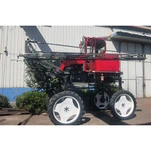
Industry Insights on 2000-Liter Boom Sprayers: How to Achieve Efficient Field Spraying with a 100-HP Tractor
With the advancement of modern agriculture, an increasing number of farms are adopting large-scale agricultural machinery to boost operational efficiency. Among these, the boom sprayer-a common piece of crop protection equipment-is widely used for the routine management of crops such as wheat, corn, soybeans, cotton, and vegetables.
Today, we will explore a highly practical piece of agricultural equipment: the 2000-liter boom sprayer, designed for use with a 100-horsepower (HP) tractor.
I. What is a 2000-liter boom sprayer?
A 2000-liter boom sprayer is a type of agricultural machinery primarily used for spraying operations in fields. Typically towed by a tractor, it draws power from the tractor to evenly distribute a mixture of water and pesticides (the spray solution) across crops.
The unit features a large-capacity 2000-liter tank and boom arms extending from both sides. Equipped with multiple nozzles, these booms allow for large-area spraying in a single pass.
Compared to traditional manual knapsack sprayers, boom sprayers offer higher efficiency, a wider coverage area, and greater ease of operation-making them ideal for large-scale farmland.
II. What are the main components of a 2000-liter boom sprayer?
A 2000-liter boom sprayer generally consists of the following key components:
1. 2000-Liter Spray Tank
The tank is a critical component of the machine, serving as a reservoir for the spray solution.
Its 2000-liter capacity minimizes the need for frequent refilling and chemical mixing, allowing the machine to cover more ground on a single fill.
These tanks are typically constructed from corrosion-resistant plastic, which is lightweight, durable, and easy to clean.
2. Boom System
The boom system is one of the most essential working components of the sprayer. It is typically mounted at the rear of the machine and can be extended to both sides. Multiple nozzles are installed along the boom; during operation, the chemical solution is sprayed evenly onto the surface of the crops through these nozzles.
Depending on the size of the farmland and specific operational requirements, the boom width can be selected from various specifications-for example, 12, 14, 16, or 18 meters.
A wider boom allows for a larger area of farmland to be covered in a single pass at the same operating speed.
3. Spray Pump
The spray pump is primarily responsible for drawing the chemical solution from the tank and delivering it to the boom system.
It provides consistent liquid pressure to the nozzles, ensuring that each one functions correctly.
A high-performance, reliable spray pump helps the machine achieve a more uniform spraying effect.
4. Nozzles and Filtration System
The nozzles break the chemical solution down into fine droplets, which are then sprayed onto the crops.
Different types of nozzles produce droplets of varying sizes, catering to diverse spraying requirements.
The filtration system is designed to remove impurities from the chemical solution, preventing the nozzles from becoming clogged and ensuring the machine operates properly.
5. Hydraulic Folding System
Large booms typically feature a hydraulic folding design.
During field operations, the boom can be extended to increase the spraying width; for road transport or when navigating narrower areas, the hydraulic system allows the boom to be folded up.
This design enhances convenience during both operation and transport.
III. Why is a 2000-liter boom sprayer well-suited for a 100-horsepower tractor?
A 100-horsepower tractor is highly versatile across many agricultural production scenarios and can be effectively paired with a 2000-liter boom sprayer.
Together, they can meet the daily crop protection needs of many medium-to-large-scale farms.
The primary reasons include:
1. Well-matched power capacity
A 100-horsepower tractor provides the necessary traction and power take-off (PTO) output required by the sprayer. Whether it involves the delivery of liquid chemicals, boom spraying operations, or the movement of the equipment across the field, a tractor is required to provide stable power support.
Naturally, the actual power requirement depends on factors such as the weight of the equipment, the width of the spray boom, the terrain, and the configuration of the pump.
2. Suitable for large-scale field operations
A 2,000-liter tank offers a substantial liquid storage capacity, which reduces the frequency of stops for refilling.
When combined with a wide spray boom, it increases the area that can be treated per unit of time.
For farms that frequently require weeding, pest control, or disease management, this configuration can save a significant amount of time.
3. Relatively simple operation
Sprayers typically operate using the tractor's power take-off (PTO) and hydraulic system.
Operators can control the sprayer's application system and the folding/unfolding of the spray booms directly from the tractor, minimizing the need for manual intervention.