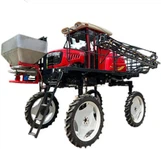
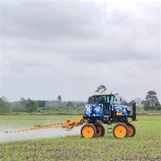
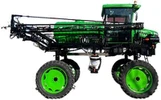
In the realm of modern agriculture, boom sprayers play a pivotal role in ensuring efficient and effective crop protection. As a leading supplier of Boom Sprayer 4WD 4WD Axle, I have witnessed firsthand the critical importance of a well - functioning axle system in a boom sprayer. One of the most significant challenges that boom sprayers face is operating on different soil types. In this blog, we will explore how our 4WD axles handle various soil conditions to optimize the performance of boom sprayers.
Understanding Different Soil Types
Soil types can be broadly classified into several categories, each with its own unique characteristics that can affect the operation of a boom sprayer. The main soil types include sandy soil, clay soil, loamy soil, and peat soil.
Sandy soil is characterized by its large particles and low water - holding capacity. It drains quickly, which means that the soil can be dry and loose. This type of soil offers relatively low resistance to wheel movement, but it can also cause the wheels to sink if the vehicle is too heavy or the tires are not properly inflated.
Clay soil, on the other hand, has very fine particles and high water - holding capacity. When wet, clay soil becomes sticky and can be extremely difficult to navigate. It can cause the wheels to slip, and the axle may experience excessive stress due to the high resistance.
Loamy soil is a mixture of sand, silt, and clay, and it is often considered the ideal soil type for agriculture. It has good drainage, water - holding capacity, and fertility. However, even loamy soil can vary in its consistency depending on the moisture content, which can still pose challenges for boom sprayers.
Peat soil is rich in organic matter and has a spongy texture. It is often found in wetland areas and can be very soft and unstable. Driving on peat soil requires special attention to prevent the vehicle from getting stuck.
How 4WD Axles Adapt to Sandy Soil
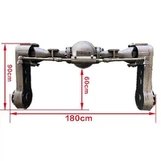
Our Boom Sprayer Axle 4×4 is designed to handle sandy soil conditions with ease. The 4WD system provides power to all four wheels simultaneously, which increases the traction and reduces the risk of the wheels sinking. When operating on sandy soil, the axle distributes the weight of the boom sprayer evenly across all four wheels. This helps to prevent the wheels from digging too deep into the sand.
In addition, our axles are equipped with advanced differential systems. The differential allows the wheels on the same axle to rotate at different speeds, which is crucial when turning on sandy soil. This feature ensures that the boom sprayer can make smooth turns without getting stuck or causing excessive damage to the soil.
Another important aspect is the tire selection. We recommend using tires with a wide tread pattern and low tire pressure when operating on sandy soil. The wide tread pattern provides more surface area in contact with the sand, while the low tire pressure helps to increase the footprint of the tire, reducing the ground pressure and preventing the wheels from sinking.
Performance on Clay Soil
Clay soil presents a different set of challenges. The stickiness and high resistance of clay soil can cause the wheels to slip, which can lead to uneven spraying and damage to the crops. Our 4WD axles are engineered to overcome these challenges.
The 4WD system provides maximum torque to all four wheels, which helps to break through the sticky clay and maintain forward momentum. The differential lock feature in our axles can be engaged when necessary. When the differential is locked, both wheels on an axle rotate at the same speed, providing additional traction in slippery conditions.
To prevent the wheels from getting clogged with clay, our axles are designed with a self - cleaning mechanism. The shape of the axle housing and the wheel hubs are optimized to allow the clay to fall off easily as the wheels rotate. This helps to maintain the performance of the tires and the axle.
Navigating Loamy Soil
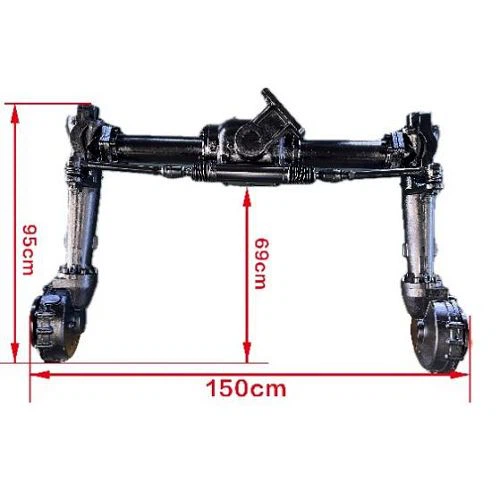
Although loamy soil is generally more forgiving than sandy or clay soil, it still requires a well - designed axle system to ensure optimal performance. Our Boom Sprayer Raised Axle is an excellent choice for loamy soil conditions.
The raised axle design provides additional ground clearance, which is beneficial when operating in fields with uneven terrain. It helps to prevent the axle from hitting rocks or other obstacles that may be hidden beneath the soil surface.
In loamy soil, the moisture content can vary significantly. Our 4WD axles are able to adapt to these changes. The intelligent traction control system in our axles continuously monitors the wheel speed and traction. If it detects a loss of traction, it automatically adjusts the power distribution to the wheels to maintain stability and forward movement.
Challenges and Solutions on Peat Soil
Peat soil is one of the most challenging soil types for boom sprayers. Its soft and unstable nature can cause the vehicle to sink and get stuck. Our 4WD axles are designed with a focus on minimizing ground pressure and providing maximum flotation.
The wide - track design of our axles helps to distribute the weight of the boom sprayer over a larger area, reducing the ground pressure. This allows the vehicle to move more easily on the peat soil without sinking. In addition, the high - torque output of our 4WD axles provides the necessary power to overcome the resistance of the soft soil.
We also recommend using special flotation tires on peat soil. These tires have a large diameter and a wide tread, which further increases the flotation and reduces the ground pressure.

The Importance of Regular Maintenance
Regardless of the soil type, regular maintenance of the 4WD axle is essential to ensure its long - term performance. This includes checking the fluid levels, inspecting the seals and bearings for wear, and lubricating the moving parts.
Proper alignment of the axle is also crucial. Misaligned axles can cause uneven tire wear, reduced traction, and increased fuel consumption. We recommend having the axle alignment checked regularly by a professional technician.
Conclusion
As a supplier of Boom Sprayer 4WD 4WD Axle, we understand the importance of providing high - quality axles that can handle different soil types. Our 4WD axles are designed with advanced technology and engineering to ensure optimal performance in a variety of soil conditions. Whether it's sandy soil, clay soil, loamy soil, or peat soil, our axles can provide the traction, stability, and durability needed for efficient boom sprayer operation.
If you are in the market for a reliable boom sprayer axle, we invite you to contact us for more information and to discuss your specific requirements. Our team of experts is ready to assist you in finding the perfect axle solution for your boom sprayer.
References
- Brady, N. C., & Weil, R. R. (2002). The nature and properties of soils. Prentice Hall.
- Hillel, D. (1998). Environmental soil physics. Academic Press.
- Soane, B. D., & van Ouwerkerk, C. (1994). Soil compaction in crop production. Elsevier.