In the agricultural machinery sector, boom sprayers play a pivotal role in efficient crop protection and fertilization. As a dedicated boom sprayer axle supplier, I am often confronted with various technical inquiries from customers. One of the most frequently asked questions is: "What is the maximum load angle a boom sprayer axle can tolerate?" This question is not only crucial for understanding the performance limits of boom sprayer axles but also for ensuring the safety and efficiency of agricultural operations.
Understanding the Concept of Load Angle in Boom Sprayer Axles
Before delving into the maximum load angle, it is essential to understand what load angle means in the context of boom sprayer axles. The load angle refers to the angle at which the axle is subjected to a load relative to its normal operating position. In practical terms, it is the angle between the vertical axis of the axle and the line of action of the load. This angle can be influenced by a variety of factors, including the terrain on which the boom sprayer operates, the distribution of the load on the sprayer, and the design and configuration of the axle itself.
When a boom sprayer is operating on uneven terrain, such as sloped fields or fields with ruts, the axles are likely to experience load angles that deviate from the normal vertical position. These non - vertical load angles can have a significant impact on the performance and durability of the axles. For instance, a large load angle can increase the stress on the axle components, such as the bearings, shafts, and housing. This increased stress can lead to premature wear and tear, and in extreme cases, it can even cause the axle to fail.
Factors Affecting the Maximum Load Angle
Terrain Conditions
The terrain on which the boom sprayer operates is one of the primary factors affecting the load angle. In hilly or sloped areas, the axles will naturally experience a greater load angle as the sprayer moves up and down the slopes. Fields with deep ruts or uneven surfaces can also cause the axles to tilt at an angle, increasing the load angle. For example, if a boom sprayer is operating on a slope with a gradient of 15 degrees, the axles will be subjected to a load angle that is significantly different from when it is operating on a flat surface.
Load Distribution
The way the load is distributed on the boom sprayer also plays a crucial role in determining the load angle. A boom sprayer typically carries a large amount of liquid, such as pesticides or fertilizers, in its tank. If the tank is not filled evenly or if there is an imbalance in the weight distribution due to other equipment on the sprayer, it can cause the axles to bear the load at an angle. For example, if the tank is over - filled on one side, the axle on that side will experience a higher load angle.


Axle Design and Configuration
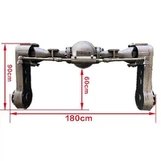
The design and configuration of the axle itself are important factors in determining the maximum load angle it can tolerate. Different types of axles, such as Boom Sprayer Axle 4×4, have different structural characteristics and load - bearing capacities. Axles with a more robust design, better suspension systems, and higher - quality materials are generally able to tolerate larger load angles. Additionally, the configuration of the axle, such as whether it is a raised axle or a standard axle, can also affect its ability to handle load angles. Boom Sprayer Raised Axle and Boom Sprayer Raised Chassis are designed to provide better ground clearance and stability, which can help in reducing the load angle under certain operating conditions.
Determining the Maximum Load Angle
Determining the maximum load angle that a boom sprayer axle can tolerate is a complex process that involves a combination of theoretical calculations, laboratory testing, and real - world field trials.
Theoretical Calculations
Engineers use various engineering principles and mathematical models to calculate the maximum load angle. These calculations take into account factors such as the material properties of the axle components, the geometry of the axle, and the expected loads on the axle. For example, the stress analysis of the axle under different load angles can be performed using finite element analysis (FEA) software. This software can simulate the behavior of the axle under various loading conditions and predict the maximum load angle at which the stress in the axle components will exceed the allowable limits.
Laboratory Testing
In addition to theoretical calculations, laboratory testing is also an important step in determining the maximum load angle. Axles are tested in a controlled laboratory environment using specialized testing equipment. These tests can simulate different load angles and loading conditions to measure the performance and durability of the axles. For example, a fatigue test can be conducted to determine how many cycles of loading at a particular load angle the axle can withstand before failure.
Field Trials
Real - world field trials are the ultimate test of the maximum load angle. Boom sprayers are tested in actual agricultural fields with different terrain conditions to observe the behavior of the axles under real - life operating conditions. These field trials can provide valuable data on how the axles perform in different environments and can help in validating the results of the theoretical calculations and laboratory tests.
Typical Maximum Load Angle Values
The maximum load angle that a boom sprayer axle can tolerate can vary depending on the type and design of the axle. Generally, for standard boom sprayer axles, the maximum load angle is in the range of 10 - 15 degrees. However, axles that are specifically designed for use in rough terrain or with heavy loads can tolerate load angles of up to 20 - 25 degrees.
It is important to note that these values are approximate and can be affected by the factors mentioned above. For example, an axle with a high - quality suspension system and a robust design may be able to tolerate a slightly higher load angle than a standard axle. On the other hand, if the terrain is extremely rough or the load distribution is highly uneven, the actual maximum load angle that the axle can safely handle may be lower than the theoretical value.
Importance of Staying within the Maximum Load Angle
Staying within the maximum load angle is crucial for several reasons. Firstly, it ensures the safety of the operators and the equipment. A large load angle can increase the risk of the boom sprayer tipping over, especially when the sprayer is moving at a high speed or when there is a sudden change in the load or terrain. Secondly, it helps in maintaining the performance and durability of the axles. By keeping the load angle within the allowable limits, the stress on the axle components is reduced, which can extend the service life of the axles and reduce the need for frequent repairs and replacements.
Contact for Purchase and Consultation
As a professional boom sprayer axle supplier, we are committed to providing high - quality axles that can meet the diverse needs of our customers. Our axles are designed and manufactured to withstand the rigors of agricultural operations, including different load angles. If you are interested in our products or have any questions regarding the maximum load angle or other technical aspects of our boom sprayer axles, please feel free to contact us. We will be happy to provide you with detailed information and assist you in making the right choice for your boom sprayer.
References
- Smith, J. (2018). Agricultural Machinery Design and Performance. Publisher: ABC Press.
- Johnson, M. (2019). Axle Design and Testing in Agricultural Equipment. Journal of Agricultural Engineering, 35(2), 123 - 135.
- Brown, T. (2020). Terrain - Induced Loads on Boom Sprayer Axles. Proceedings of the International Conference on Agricultural Machinery, 45 - 52.