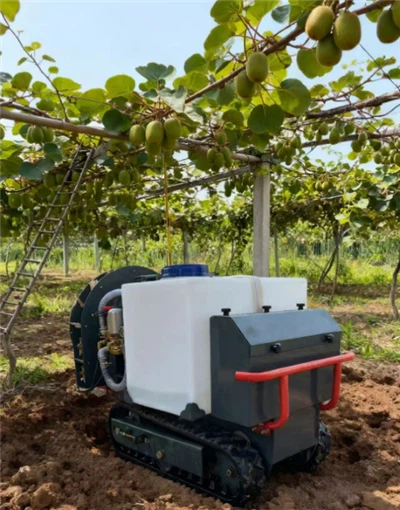
In agricultural cultivation, applying pesticides for pest control and performing routine crop protection are essential annual tasks. Traditional manual spraying is not only arduous and inefficient but also prone to issues like chemical waste and uneven coverage; furthermore, working in the fields during hot weather poses significant safety risks. Today, the widespread adoption of remote-controlled sprayers has revolutionized traditional spraying methods, making the process in farmlands, orchards, and greenhouses simple, efficient, and safe.
Compared to manual spraying, the primary advantage of a remote-controlled sprayer is the enhanced safety and peace of mind it offers. Operated entirely via remote control, the machine eliminates the need for personnel to walk through the fields. Operators can manage the spraying of an entire area from a distance, avoiding close contact with pesticides and effectively preventing risks such as chemical poisoning, sunburn, or heatstroke. This significantly reduces the physical labor involved, allowing even the elderly or women to operate the equipment with ease.
In terms of performance, remote-controlled sprayers offer greater consistency. Their superior atomization capabilities produce a fine, uniform mist that thoroughly coats both the tops and undersides of crop leaves. They can effectively penetrate dense fruit tree foliage and tightly packed greenhouse crops, ensuring complete coverage with no missed spots. Unlike manual spraying-which is prone to accidental omissions or excessive, overlapping applications-these machines provide more reliable pest and disease control, ultimately boosting crop growth and yields.
Moreover, these machines are highly economical, saving both chemicals and money. Precision spraying minimizes waste, leading to significant savings on pesticides and water. This lowers cultivation costs and reduces chemical residues, resulting in higher-quality, healthier, and more eco-friendly agricultural produce.
Another key strength is the machine's adaptability to diverse terrain. Whether on flat, expansive fields, uneven slopes, muddy ground, in orchards, or within greenhouses, these units navigate and operate with ease. Their excellent mobility and broad applicability make them suitable for a wide range of uses, including fruit orchards, vegetable farms, grain crops, and landscaping.
When it comes to operational efficiency, these machines vastly outperform manual labor. A remote-controlled sprayer offers a work efficiency equivalent to that of several manual laborers. By saving both time and effort, it is an ideal solution for individual growers, family farms, and agricultural cooperatives-effectively addressing the challenges of labor shortages and high labor costs during peak farming seasons.
Furthermore, the remote-controlled sprayer features a simple design, a low failure rate, and easy maintenance. With low fuel consumption, it offers excellent long-term value. It is straightforward to operate, requiring no specialized technical expertise; even beginners can quickly master its use, significantly lowering the barrier to adopting agricultural machinery.
Today, the shift toward mechanized and intelligent farming has become a clear trend. With its many advantages-including safety, chemical efficiency, high productivity, durability, and versatility-the remote-controlled sprayer has become an invaluable tool for crop protection. It helps farmers cultivate their land with greater ease, reduces costs, boosts yields, and drives the transition toward more efficient, convenient, and modernized agricultural production.