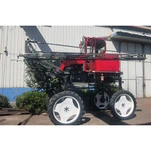
Why is a 2,000-liter boom sprayer well-suited for a 100-horsepower tractor?
A 100-horsepower (HP) tractor is highly versatile for many agricultural tasks and pairs effectively with a 2,000-liter boom sprayer.
This combination is well-suited to meet the daily crop protection needs of many medium-to-large-scale farms.
Key reasons include:
1. Optimal Power Matching
A 100-HP tractor provides the necessary traction and power take-off (PTO) output to operate the sprayer.
Whether it involves pumping liquid, managing the boom, or maneuvering the equipment across the field, the tractor delivers the stable power required for these operations.
Naturally, the actual power requirement depends on factors such as the weight of the equipment, the width of the boom, the terrain, and the specific configuration of the pump.
2. Suitable for Large-Scale Field Operations
A 2,000-liter tank offers a large liquid capacity, which reduces the frequency of stops for refilling.
When paired with a wide boom, this setup increases the area that can be treated per unit of time.
For farms that frequently require weeding, pest control, or disease management, this configuration saves a significant amount of time.
3. Relatively Simple Operation
These sprayers typically operate using the tractor's PTO and hydraulic system.
Operators can control the spraying system and the folding/unfolding of the boom directly from the tractor, minimizing the need for manual intervention.
For which crops is a 2,000-liter boom sprayer typically used?
This type of sprayer has a broad range of applications and is particularly well-suited for large-scale crop cultivation.
Common applications include:
• Wheat: For weeding, pest control, and disease management.
• Corn: For field weeding and the control of pests and diseases.
• Soybeans: For crop protection throughout the growing season.
• Cotton: For pest and disease control.
• Rapeseed (Canola): For pest and disease control and general field management.
• Vegetable Cultivation: For spraying operations tailored to the specific planting area and crop height. It should be noted that because different crops vary in height and cultivation methods, adjustments must be made to the boom height, nozzle type, and spraying pressure accordingly.
What are the advantages of using a 2,000-liter boom sprayer?
Compared to traditional manual spraying methods, a 2,000-liter boom sprayer offers several distinct advantages:
1. Higher operational efficiency
Multiple nozzles can operate simultaneously, and a wide boom allows for covering a large area in a single pass.
This is particularly important for large-scale farms.
2. Reduced labor costs
A single sprayer, paired with a tractor, can handle large-scale spraying tasks, eliminating the need for a large manual workforce.
3. Fewer refills required
A large 2,000-liter tank holds more liquid, reducing the time spent on frequent refills.
4. More uniform spraying
By properly configuring nozzle spacing, spraying pressure, and travel speed, the chemical solution can be applied to crops with greater uniformity.
5. Versatile application
By swapping out nozzle types and adjusting spraying parameters, the equipment can meet the plant protection needs of various crops.
What should you keep in mind when using a boom sprayer?
To ensure the machine functions correctly and achieves optimal spraying results, keep the following points in mind during operation:
1. Check the nozzles: Before each use, inspect the nozzles for clogs and ensure that each one is dispensing liquid properly.
2. Check the water pump: Ensure the pump is operating correctly, with no leaks or unusual noises.
3. Adjust the boom height: Set the distance between the boom and the crops appropriately, based on crop height and the type of nozzles being used.
4. Control travel speed: Maintain a relatively steady speed to avoid uneven spraying.
5. Clean the tank promptly: After each use, rinse the tank, hoses, and nozzles with clean water to minimize chemical residue.
6. Perform regular maintenance: Periodically inspect the tires, hoses, filters, hydraulic system, and all connection points, and carry out maintenance as needed.